

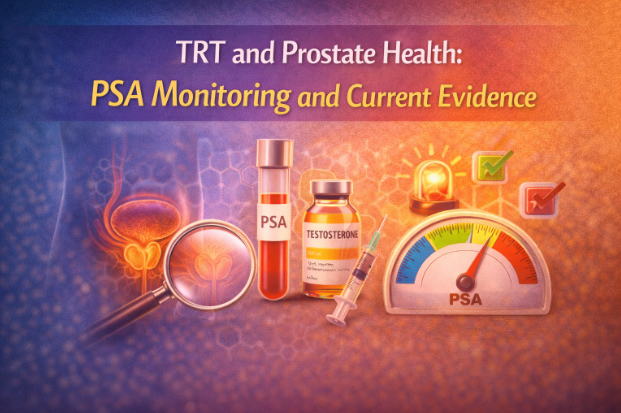

What PSA Really Means and Why You’re Still Struggling With Weight
You want help, but you are scared of making things worse
You feel tired all the time.
Your weight will not move no matter what you try.
Your motivation is gone.
You start hearing about TRT.
Then the fear kicks in.
“What about my prostate?”
“Won’t testosterone raise my PSA?”
“I don’t want to trade one problem for another.”
Patients say this every day.
“I want to feel better, not risk cancer.”
“My doctor shut the conversation down immediately.”
“I feel stuck and scared to move forward.”
Let’s slow this down and talk through what actually matters.
What Is PSA in Simple Terms?
PSA stands for prostate specific antigen.
It is a protein made by the prostate.
A small amount in the blood is normal.
Higher levels can mean many things.
PSA can go up from:
- Age
- Inflammation
- Infection
- Benign prostate growth
- Recent exercise or sex
It does not automatically mean cancer.
This is where a lot of fear starts.
Does TRT Automatically Raise PSA?
This is one of the biggest myths we hear.
Testosterone does not equal prostate cancer.
Current evidence shows that TRT does not increase prostate cancer risk when properly monitored.
PSA may rise slightly at first as the prostate responds to normal hormone levels.
Then it usually stabilizes.
What matters is how it changes over time.
Why Conventional Medicine Often Says No Right Away
In many insurance based practices, TRT is treated as risky.
PSA is checked once.
If it is borderline, the conversation stops.
There is little discussion about:
- Baseline PSA levels
- Rate of change
- Inflammation vs disease
- Overall hormone balance
Patients leave confused and afraid.
How Functional Medicine Approaches TRT and Prostate Health
Functional medicine looks at the full picture.
We use advanced testing to track:
- PSA trends over time
- Total and free testosterone
- Inflammation markers
- Hormone balance
- Metabolic health
We do not chase one number.
We watch patterns.
This allows care to be thoughtful and safe instead of reactive.
Why Hormones and Weight Loss Are Connected
Low testosterone slows your metabolism.
It makes it harder to build muscle.
It increases fat storage.
It raises inflammation.
This is why so many people ask questions like, “Is tirzepatide a peptide?” or look into semaglutide.
They are trying to solve weight loss without addressing hormone signals.
Peptides like tirzepatide can help appetite and blood sugar.
They do not fix hormone imbalance.
The Goal Is Not More Testosterone
The goal is balance.
That includes:
- Healthy hormone levels
- Stable PSA monitoring
- Reduced inflammation
- Improved metabolic function
Supportive tools like peptides, nutrition, stress management, and even foundational support like hydrolyzed bovine collagen peptides can help the body recover and respond better to movement and healing.
This is about helping your body work again.
Why You Deserve a Better Conversation
You should not feel scared to ask questions.
You should not feel shut down.
You should not feel like you have to choose between feeling better and staying safe.
Your symptoms matter.
Your fears are valid.
Your health deserves more than a quick no.
Want to Learn More Without Pressure?
If you want to understand TRT, prostate health, and weight loss resistance without being pushed into treatment, education is the best place to start.
Our podcasts and webinars break down the evidence, the myths, and the root causes behind stubborn weight gain and low energy.
No pressure.
No rush.
Just clear explanations that help you make informed decisions when you are ready.
When you understand the full picture, the path forward feels a lot less scary.